Snap-In Implant Dentures in Redwood City: How Many Implants?
· Carlmont Dental Care
Wondering how many implants a snap-in lower denture needs? Here is what recent research says about one versus two implants, attachment types, and age, in plain language.
Short answer: Two implants is the most commonly cited standard for a lower overdenture (for example, in the McGill and York consensus statements), and research is examining whether one may suffice for select patients. The right number (one, two, or more) and the right attachment depend on your jaw, your bite, your age and health, and your goals, so it is a personalized decision rather than a one-size-fits-all rule.
What is a snap-in implant denture?
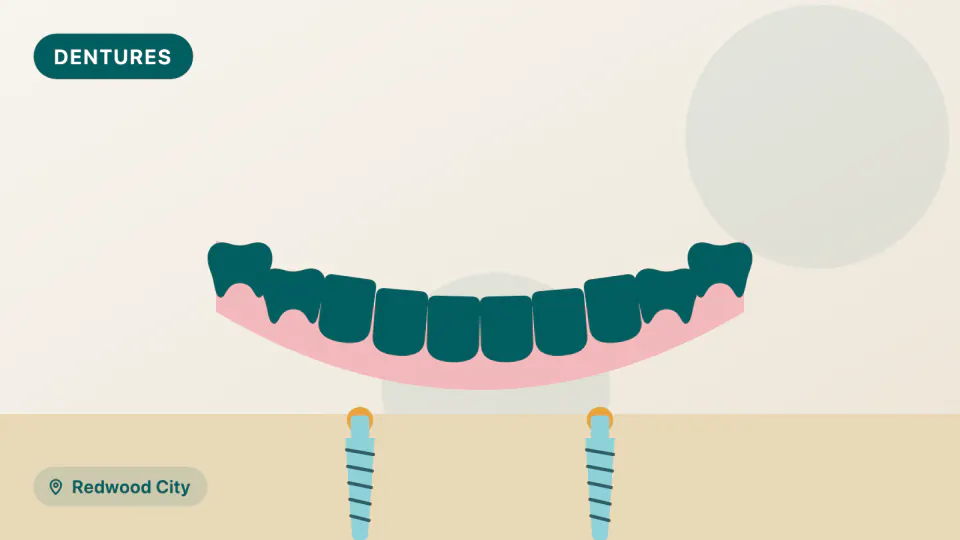
A snap-in denture, also called an implant overdenture, is a removable denture that clicks onto small attachments on dental implants placed in the jawbone. The implants act like anchors. The denture is typically more stable than a conventional one, and you can still take it out to clean it.
Many of the questions we hear from Redwood City families start the same way: a loose lower denture that slides when eating or talking. The lower jaw is usually the hardest place to keep a denture stable, which is why it is where snap-in designs are most often discussed.
Is one implant enough, or do you need two?
Two implants in the lower jaw has long been the most commonly cited standard for an overdenture, and it is the approach named in widely referenced consensus statements such as the McGill and York statements. Newer research has asked whether a single central implant could do the job for some patients.
Here is what recent reviews of the evidence suggest, without overstating it:
- Implant survival looks similar. A review of 17 randomized trials found no difference in how long the implants themselves lasted over about five years, whether a lower denture used one implant or two.
- Short-term results are encouraging, but not conclusive. A broader umbrella review that gathered together earlier reviews found that some analyses showed a trend toward fewer implant failures with one implant, but differences were generally not statistically significant.
- The denture itself may need more repair. With one implant, the denture was more likely to fracture, need remaking, or need its metal housing reattached. Researchers describe it as a less invasive option that calls for careful case selection.
- Long-term data are still maturing. Results on satisfaction and quality of life were inconclusive, and the authors called for more well-designed studies.
In plain terms, a single implant is not a shortcut for everyone. It can be a reasonable option for some people, particularly when surgery needs to be kept minimal, but it may mean more maintenance on the denture over time.
Age and attachment type can both factor in
Your dentist will weigh age and attachment type together with your overall health. Studies suggest implants in older adults can have high survival rates, including in people over 75. Daily cleaning matters at every age, and plaque control becomes especially important as dexterity or health changes. Health, medications, and bone quality are evaluated individually, so age is only one piece of the picture.
Attachment type is another consideration. Some overdentures use a bar that joins the implants together (splinted), while others use individual, stand-alone attachments. Research on implant survival is mixed, and overall survival is generally high with either design. Differences between them show up more in denture retention and in mechanical maintenance, such as how often parts wear or need replacing.
So a bar is not automatically better, and individual attachments are not automatically worse. The choice usually depends on jaw anatomy, the number of implants, how easily you can clean the area, and how much maintenance you are prepared for. Bars can add stability but may be harder to keep clean and may not suit every jaw. Individual snaps are simpler and easier to clean. A dentist will typically weigh these tradeoffs with you.
How do dentists decide the right number of implants?
Dentists often look at several things before recommending a plan:
- Bone quantity and quality, usually checked with a 3D scan.
- Your bite and chewing habits, since heavy biting forces can stress a denture on a single implant.
- General health, including conditions that affect healing, such as smoking and uncontrolled diabetes, and whether you can manage daily cleaning.
- Dexterity and preference, because some people want a simple snap design while others want maximum stability.
- Upper versus lower jaw. The upper jaw generally has softer bone and often needs a different plan than the lower.
All implant surgery carries risks, including infection, implant failure, and delayed healing, and your dentist can walk you through them during a consultation.
Cost and time matter too. The investment varies with the number of implants, the attachment design, and whether bone grafting is needed. A written estimate after your consultation is the only reliable way to see your numbers. Our office accepts most PPO plans, offers in-house membership plans, and can discuss 0% APR financing through CareCredit or Proceed Finance.
Seeing us from Redwood City
Many patients visit our Belmont office from Redwood City, and it is a short drive for many of them. If you are comparing options, you can read more about why patients look for the best dentist in Redwood City, CA and what we offer nearby.
Common questions about snap-in implant dentures
Q: Can I get a snap-in denture if I have been wearing a regular denture for years?For many patients, yes. What matters most is whether there is enough healthy bone and gum tissue, along with your general health. An exam and imaging with a licensed dentist can show whether implants can be placed directly or whether bone needs support first.
Q: Is a single-implant lower denture just as good as two implants?The implants themselves appear to last about as long in the trials reviewed, but the denture can need more repairs with one implant. Patient-reported outcomes are still being studied, so it is best discussed case by case.
Q: Am I too old for implants?In most cases, age alone is not the deciding factor. Research on adults over 75 has found high implant survival rates. Your overall health, medications, bone quality, and ability to keep the area clean are evaluated individually and often carry more weight than your birthday.
Q: Will I still need to take the denture out?Yes. A snap-in denture is removable, so you can clean the denture and the attachments properly each day. That helps support implant health.
Take the next step
If you are a Redwood City resident who is tired of a loose denture, we would be glad to talk it through. Call our Belmont office at (650) 591-1984 or visit carlmontdentalcare.com to schedule a consultation. We serve patients in Redwood City and nearby cities across San Mateo County, and Mandarin- and Spanish-speaking team members are available.
This article is general education, not a diagnosis or individual medical advice. Whether implants are right for you can only be determined after an exam and imaging with a licensed dentist. Candidacy depends on health factors such as smoking and uncontrolled diabetes, and all surgery carries risks.
From our patients
★★★★★“Great people! Everyone smiled and made me feel good about coming here for my dental needs. Nancy helped me remove the Invisalign attachments, the whole process really felt like a family dental care, were very personable and caring, and worked with me as best they can to plan and resolve my crown problem.”
★★★★★“I lost a crown on a molar. I made an appointment. They were ready to take me at the correct time and Date. They were efficient and professional a very enjoyable experience.”