Snap-In Dentures in Half Moon Bay: How Many Implants Do You Need?
· Carlmont Dental Care
One, two or four implants? Recent research suggests the right count for a snap-in denture depends on your jaw, health and goals. Here's what the evidence shows so far.
For a lower snap-in denture, two implants has long been a widely recommended minimum, but published research suggests a single implant can perform comparably for implant survival over the first several years, with a few trade-offs. Some people, especially those with an upper denture or who want extra stability, are better served by more implants. The right number and the right attachment depend on your jaw, your health and your goals, so there is no one-size-fits-all answer.
This article is general education, not individual medical advice. Candidacy and risks (including infection, implant failure, and effects of smoking, diabetes and certain medications) must be evaluated by a dentist in an exam.
How many implants does a snap-in denture actually need?
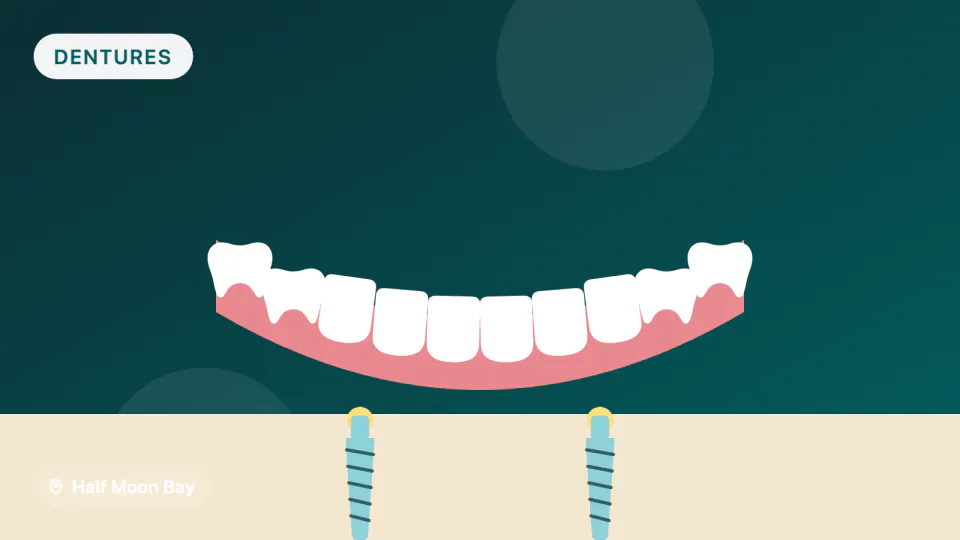
An implant overdenture is a removable denture that clicks onto small attachments on dental implants. It is designed to stay more stable when you chew and talk than a conventional denture, and you can still take it out to clean it. The number of implants behind it varies:
- One implant: a single implant in the middle of the lower jaw. It is a simpler, less invasive option, and it is generally considered only for selected patients after evaluation.
- Two implants: a widely studied lower-jaw design, and a commonly used baseline for many years.
- Four or more implants: often considered for the upper jaw, where bone tends to be softer, or when someone wants a firmer, more stable fit.
A dentist will usually decide among these after evaluating your bone with imaging, checking how your current denture fits, and talking through what bothers you most day to day.
What does recent research say about one versus two implants?
Published systematic reviews have pulled together the results of randomized trials comparing one-implant and two-implant lower overdentures. The pattern is fairly consistent: implant survival, bone loss around the implant, and short-term outcomes look comparable over the first several years.
These reviews also tend to find that the one-implant design comes with more prosthetic maintenance. Denture fractures, metal housing reattachments and the need for a new denture were more common over time, which makes sense because the chewing load is concentrated on one point. Reinforcing the denture can help reduce that risk.
What the evidence does not yet show: most of these trials followed patients for five years or less. Long-term results, and differences in patient-reported satisfaction, are still being studied. Researchers continue to call for longer follow-up, so one implant is best viewed as a reasonable option for selected patients after evaluation, not a replacement for the two-implant baseline.
Does age change the picture?
Published reviews suggest implant survival in older adults is generally high, and age alone has not been shown to rule out implants. A dentist will still weigh general health, medications and how well you can clean around the attachments.
Many of these studies have fairly short follow-up, so results may look a little optimistic over the very long term. Medical conditions and medications were not consistently reported, which means your own health history matters more than any pooled average.
Do snap-in attachments differ, and does it matter?
Attachments are the small connectors that hold the denture on. Individual snaps (ball or low-profile types) are the most common. Another approach joins the implants with a connecting bar. Reviews of attachment types have not found a clear, consistent link between attachment style and implant survival. Some studies suggest bars may provide more retention, though findings vary, while some snap-in styles work better when there is limited space between the jaws. Bars can also be harder to clean, and all attachments wear and need periodic replacement parts. This is exactly why attachment choice is individualized.
Risks and who may not be a candidate
Implant treatment is a surgical procedure, and it carries risks such as infection, implant failure, and gum and bone inflammation around the implant (peri-implantitis). Smoking, poorly controlled diabetes, certain medications (including some bone-strengthening drugs) and a history of radiation to the jaw can raise those risks. A dentist needs to review your health history and examine you before saying whether snap-in dentures are appropriate.
Planning snap-in dentures if you're coming from Half Moon Bay
We welcome patients from Half Moon Bay who have been struggling with a loose lower denture and want to know whether a lighter treatment plan could work. Our Belmont office is a short drive over Highway 92. If you're still choosing a dental home, our page on the best dentist in Half Moon Bay, CA explains how our office serves coastal patients.
Cost is understandably part of the decision. The investment varies with the number of implants, the type of attachment and whether the denture needs to be remade. Financing with 0% APR options is available through CareCredit and Proceed Finance.
Common questions about snap-in implant dentures
Q: Is one implant enough for a lower denture?For some people, possibly. Studies suggest survival is comparable to two implants over the first several years, but you may need more denture repairs or adjustments. A dentist can tell you whether your jaw shape and bite make one implant realistic.
Q: Why might I need four implants instead of two?Upper dentures, softer bone, or a wish for extra stability often lead dentists to recommend more implants to spread the chewing forces.
Q: Am I too old for implants?Age alone is not usually the deciding factor. Overall health, healing ability and your ability to keep the area clean matter more.
Q: Can I still remove the denture?Yes. A snap-in denture is meant to be taken out daily for cleaning, and the attachments need occasional replacement parts over time.
If you're weighing one, two or four implants, a consultation can help you compare options based on your own exam and goals. Call our Belmont office at (650) 591-1984 or visit carlmontdentalcare.com to schedule. We welcome patients from Half Moon Bay and nearby coastal communities.
From our patients
★★★★★“Great people! Everyone smiled and made me feel good about coming here for my dental needs. Nancy helped me remove the Invisalign attachments, the whole process really felt like a family dental care, were very personable and caring, and worked with me as best they can to plan and resolve my crown problem.”
★★★★★“I lost a crown on a molar. I made an appointment. They were ready to take me at the correct time and Date. They were efficient and professional a very enjoyable experience.”