Screw-Retained vs. Cemented Implant Crowns: What Trials Show
· Carlmont Dental Care
Screw-retained or cemented implant crown? Recent reviews suggest little lasting difference in bone loss, but screw retention avoids hidden cement and is easier to service.
Short answer: Recent pooled studies suggest the method of attachment, with a screw or with dental cement, may make little lasting difference to the bone around an implant, though the evidence is still developing. Screw-retained crowns are now a common starting point mainly because they avoid leftover cement under the gum and can be removed for repair. Cemented crowns still have a place in some mouths, and the long-term evidence is still maturing.
What is the difference between screw-retained and cemented implant crowns?
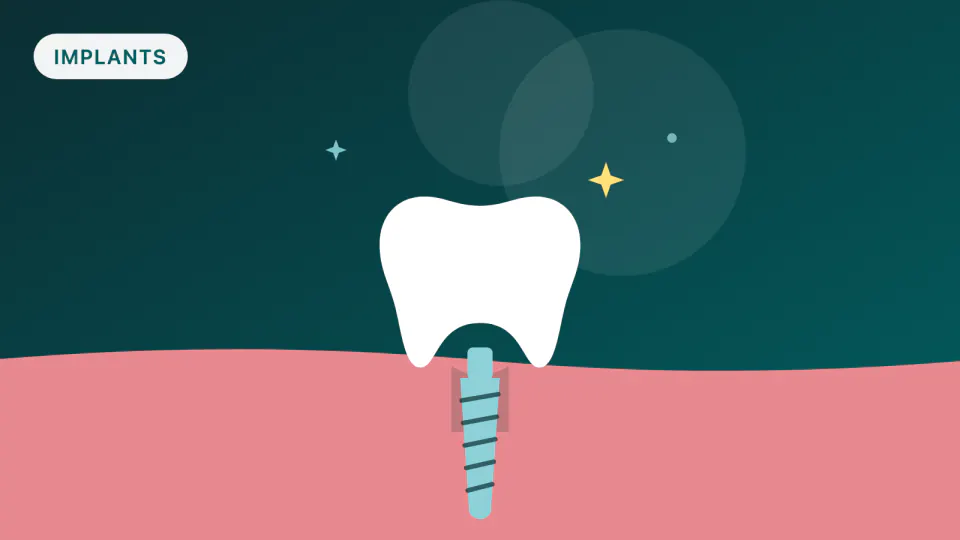
A dental implant has three parts: the implant in the jaw, a connector called an abutment, and the crown you chew with. The question is how the crown attaches to the abutment.
- Screw-retained: a small screw holds the crown in place. A tiny access channel is sealed with a tooth-colored filling after placement.
- Cemented: the crown is bonded onto the abutment with dental cement, much like a crown on a natural tooth.
Both approaches have been used for decades. The newer question is whether one protects the surrounding bone and gums better than the other.
Does the retention method change bone loss?
For the most part, the research so far suggests it does not. Systematic reviews that looked at which prosthetic design choices affect bone loss around implants generally did not find a significant difference between screw and cement. The factors that appeared to matter more were using a narrower abutment on a wider implant (called platform switching), choosing an abutment of adequate height, and not repeatedly removing and reattaching the abutment during treatment (a 'one abutment, one time' approach).
Reviews of zirconia (tooth-colored ceramic) implant crowns tell a similar story, with some nuance:
- Some pooled analyses that followed zirconia crowns for several years found slightly less bone loss with screw-retained crowns early on, but the difference was generally not significant at later follow-up. Gum health measures such as bleeding were similar.
- Some of those analyses also suggested slightly fewer complications with screw retention. This is a possible signal, but the studies they combined were not all randomized trials, so it should be read cautiously.
- A 2026 review that included only randomized trials of zirconia crowns found a very small difference in bone loss, slightly favoring cemented crowns. Its authors considered that difference small, and they noted that many of the trials had some risk of bias. It found no meaningful difference in other complications, such as crown fracture or screw loosening.
These results do not line up perfectly, and that is worth being honest about. Together they suggest that any bone difference is small, shows up mostly early on, and may depend on the materials and techniques used. They do not show that one method is clearly better for bone.
Why is cement the concern?
The issue is not the cement itself but cement left behind. When a crown is cemented, excess material can squeeze out below the gum line, where it is hard to see and hard to clean. Studies have linked leftover cement to gum inflammation, bleeding, and bone loss around implants. Some clinical reports have found residual cement in many cases of peri-implant disease around cemented crowns, although that association does not prove the cement was the cause. Cement can also be difficult to spot on X-rays.
This risk can be reduced. Cement is easier to control when the crown edge sits at or just below the gum line, and a custom-made abutment helps position it there. Some reviews conclude that with careful technique, cemented crowns can perform comparably to screw-retained ones. Screw retention simply removes the question.
What about retrievability?
Implants can last many years, but the crown on top may need attention along the way, such as a worn contact, a chipped porcelain surface, or a loose component. A screw-retained crown can usually be unscrewed, repaired or cleaned, and put back. A cemented crown can be harder to remove, and sometimes has to be cut off, which risks damaging it. Retrievability is one of the main practical reasons screw retention has become a common default when the implant position allows it.
Screw retention has trade-offs too. If the implant sits at a steep angle, the screw access hole can land in a visible spot on the tooth. Cemented crowns can be simpler to fabricate and may suit certain angled or tight-space situations. A dentist will typically weigh the implant's position, the bite, and the look of the front teeth when choosing.
Common questions about implant crown retention
Q: Is a screw-retained crown less attractive?
A: Usually not. The access channel is filled with matching material and is rarely noticeable. In some angled front-tooth cases, a cemented crown may look more natural.
Q: Will a screw-retained crown come loose?
A: Screw loosening can happen with any implant restoration. In one 2026 review of randomized trials of zirconia crowns, screw loosening rates did not differ meaningfully between the two methods. Other analyses have reported different complication rates, and results vary. If loosening occurs, a screw-retained crown can generally be tightened without replacing the crown.
Q: Does the choice affect how long my implant lasts?
A: Some reviews report similar survival rates for both methods over about five years. Longer follow-up and better randomized trials are still needed.
Q: What can I do to protect the bone around my implant?
A: Keep up with daily cleaning around the implant and regular checkups. Design factors like platform switching and avoiding repeated abutment removal also play a role, and a dentist can explain how they apply to your case.
Talk it through in Belmont
If you are considering an implant, or have one and want to understand what kind of crown it has, a consultation is a good place to start. Our team at 2100 Carlmont Drive, Suite 8 in Belmont can review your situation and give you a written estimate. We accept most PPO plans, offer in-house membership plans, and have 0% APR financing options through CareCredit and Proceed Finance, subject to credit approval; terms and qualifying promotional periods vary. Call (650) 591-1984 or visit carlmontdentalcare.com to schedule.
This article is general education and not a substitute for an exam and individualized advice from your dentist.
From our patients
★★★★★“I’ve been searching for a new dentist near my home and found dr jiang. Her office is very clean and her staff is very professional. I had a few cavities and she gave me a few options. I never felt pushed. Would recommend to anyone who’s looking for a new dentist in the Belmont area.”
★★★★★“Great people! Everyone smiled and made me feel good about coming here for my dental needs. Nancy helped me remove the Invisalign attachments, the whole process really felt like a family dental care, were very personable and caring, and worked with me as best they can to plan and resolve my crown problem.”