Receding Gums in San Mateo: Gum Grafting Options & What Research Shows
· Carlmont Dental Care
Why gums recede, when grafting is worth considering, and what research suggests about root coverage, own-tissue grafts versus collagen matrix substitutes, risks, and recovery. For San Mateo patients.
Receding gums can often be treated. Gum grafting can reduce or cover exposed roots in many cases, though results vary with the type and depth of recession. Pooled results from dozens of randomized trials show that root-coverage surgery covers about 83% of an exposed root on average, and fully covers the root in roughly 63% of treated teeth. Those are averages, not promises, and your own result depends on your anatomy, your habits and the technique used. A graft from your own mouth is the most widely used reference approach, while a collagen matrix substitute trades a little recession reduction for a shorter procedure with no second surgical site. Not every recession needs surgery, so the first step is understanding why the gums are pulling back.
Why do gums recede in the first place?
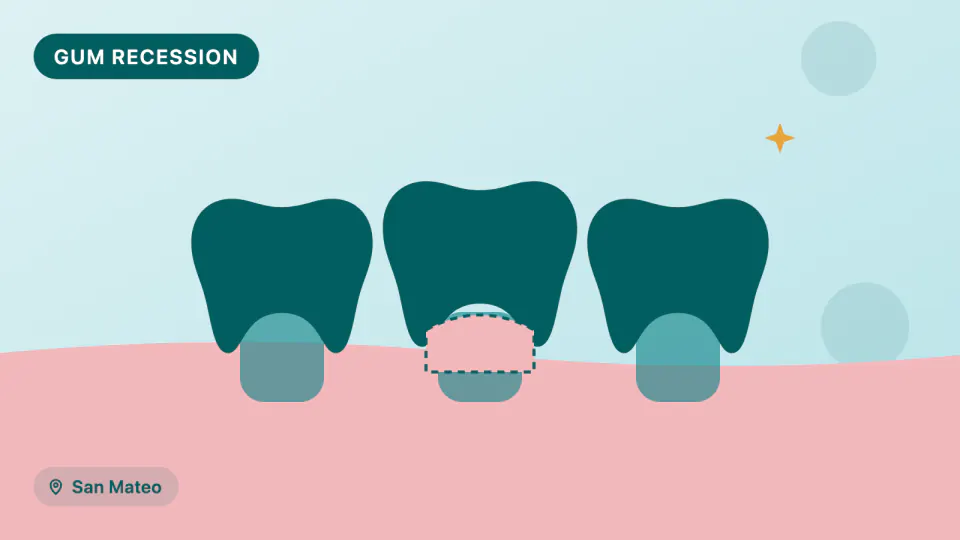
Recession happens when the gum edge slides away from the crown of a tooth and exposes the root. It rarely has a single cause. Some people are simply built with thin gum tissue, thin bone over the root, or a tooth sitting slightly outside its bony housing. Those traits set the stage. Then something tips it over: brushing too hard or with a stiff brush, plaque-driven inflammation, gum disease, tobacco, lip or tongue piercings, some orthodontic tooth movement, or a restoration edge that sits below the gumline.
It matters because root surface is softer than enamel. Exposed roots are more prone to cold sensitivity, notching and root cavities, and the tooth can look longer than its neighbors.
Does every receding gum need a graft?
No. Dentists generally start by dealing with the cause: refining brushing technique, treating inflammation or gum disease, and measuring the recession so it can be tracked over time. Long-term studies of untreated recession suggest it tends to progress slowly, often by less than a millimeter to about a millimeter over many years. Teeth that already have recession are more likely to lose more, though, and the pace varies from person to person.
Surgery is typically considered when one of these applies:
- Sensitivity or appearance bothers you.
- Measurements show the recession getting worse from one checkup to the next.
- A tooth with thin tissue is about to have orthodontic or restorative work.
Grafting a stable tooth purely as prevention is generally not recommended.
How well does gum grafting work, and which type fits?
A pooled analysis of 32 randomized trials, covering about 1,000 patients and more than 3,500 recessions, found an average of 82.6% root coverage and 62.7% complete coverage. Patients rated their satisfaction with the look of the result at about 8.6 out of 10 on average. Again, these are averages, not promises. Shallower recession with healthy bone and gum between neighboring teeth tends to respond best, and deeper defects with bone loss between teeth are less predictable. Some studies also report reduced root sensitivity after surgery, though findings vary.
Your own tissue versus a substitute
The classic approach moves a thin piece of connective tissue, usually from the palate, under the gum over the exposed root. Substitutes such as collagen matrix avoid that second surgical site. The trial evidence on substitutes mostly concerns collagen matrix specifically, and it does not necessarily apply to other donor-tissue products. In a small group of trials followed for about 12 months, collagen matrix shortened surgery time, and some studies report less palate discomfort. However, the patient's own tissue gave somewhat more recession reduction and more thickening of the gum on some measures, which is why it remains the most widely used reference approach. A substitute can be a reasonable choice when palate tissue is limited, when health factors make a second site undesirable, or when a patient strongly prefers to avoid it. Those trials were few and short, and longer-term data are still maturing.
Tunnel technique versus coronally advanced flap
Both methods reposition gum over the root. A flap slides the gum upward, while the tunnel technique creates a pocket beneath the gum and tucks the graft in without cutting between the teeth. Pooled studies suggest both can work well, and some analyses have hinted at small differences that were not consistent across comparisons. Some clinicians value tunnel approaches for healing and appearance, while others find a flap may thicken the gum slightly more, and the evidence is mixed. The choice usually comes down to the shape of the recession, how many teeth are involved, and the clinician's experience.
Risks to understand
Gum grafting is surgery, and like any surgery it carries risks. These include bleeding or infection at the treated area or the palate site, swelling, discomfort, graft failure or incomplete root coverage, and the possibility that recession returns or another procedure is needed. Smoking and poor plaque control raise the chances of a poorer result. A clinician should walk you through these risks before you decide.
What is recovery like, and what do San Mateo families ask?
If you live in San Mateo neighborhoods such as Hillsdale, Baywood or Shoreview, common questions include: how sore will it be, and when can I get back to work? Many patients report mild to moderate discomfort for the first several days, and the palate site is often sorer than the treated gum. Dentists typically recommend soft, cool foods, a gentle approach to cleaning the area, and follow-up visits to check healing. Your dentist will give you instructions specific to your procedure, and exact instructions vary by technique.
Our Belmont office is a short drive from San Mateo. At a first visit, we can evaluate your gums, measure the recession, check gum thickness and bite habits, and talk through options. When surgery is appropriate, we can coordinate care with a periodontist. The investment varies with the number of teeth, the type of graft and the complexity of the case, and the office performing the procedure can provide a written estimate after your evaluation. We work with many PPO plans, so please call to verify your coverage. We also offer in-house membership plans starting at $30 per month, and can discuss financing options through CareCredit and Proceed Finance, which are subject to credit approval, with terms that vary by plan.
If you are still choosing a dental home, our overview of the best dentist in San Mateo, CA explains how our office approaches care for local families.
Common questions about gum recession treatment
Q: Will my gums grow back on their own?Lost gum tissue does not regrow by itself. Removing the cause, such as hard brushing or inflammation, can stop it from getting worse. Restoring covered root generally requires a graft.
Q: Can recession come back after a graft?It can, particularly if the original cause is still there. Gentle brushing, controlled inflammation and regular checkups help protect the result. Most trials follow patients for about a year, so very long-term data are more limited.
Q: Can I avoid having tissue taken from the roof of my mouth?Sometimes. Collagen matrix substitutes avoid a second surgical site, and some studies report less discomfort with them, though the patient's own tissue often gives slightly better results on some measures. Whether a substitute suits you depends on the tooth, the defect and your health.
Q: Is gum grafting always cosmetic?No. Many people seek treatment for sensitivity or to protect an exposed root, and appearance is one benefit among several.
Next step
If you have noticed longer-looking teeth or new sensitivity, an exam can tell you whether your gums are stable or changing and which options may fit. We are serving patients in San Mateo and nearby cities at 2100 Carlmont Drive, Suite 8, in Belmont. Call (650) 591-1984 or visit carlmontdentalcare.com to schedule.
This article is general education and not a substitute for an exam. Whether grafting is right for you depends on a clinical evaluation.
From our patients
★★★★★“I had my first visit at Carlmont Dental Care today for routine dental check-up and cleaning. The facility was clean and pleasant, the staff were friendly and helpful, and Dr. Jiang was knowledgeable, patient, and very gentle when she did”
★★★★★“Very fast, friendly and clean. I really enjoyed my most recent visits, the staff is kind and really helpful when it comes to insurance purposes. The hygienist is very sweet and really helps you understand how to keep your mouth happy.”