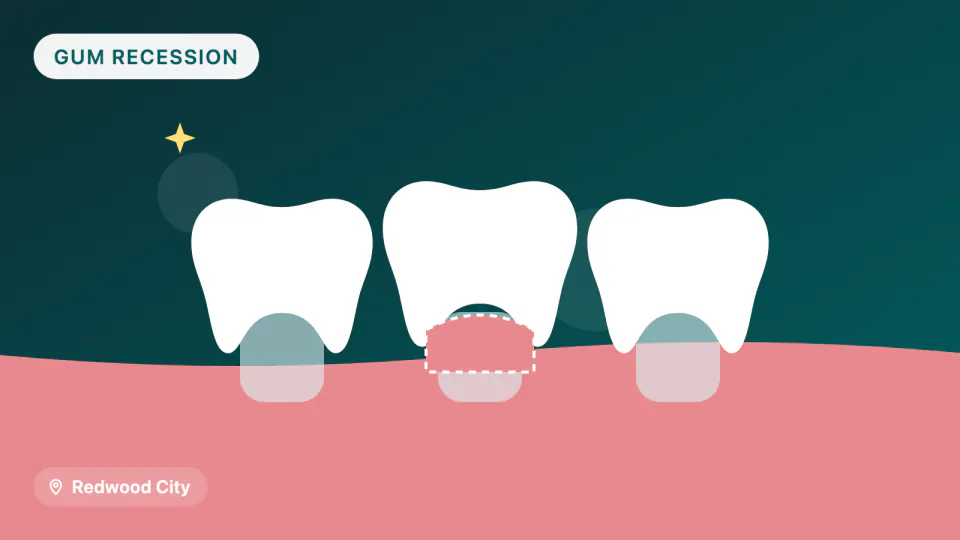
Receding Gums in Redwood City: Gum Grafting Options & Results
· Carlmont Dental Care
Receding gums don't regrow on their own. Learn why recession happens, when treatment may be considered, and what research says about grafting with your own tissue versus a substitute.
Gum recession doesn't reverse by itself, but not every case needs surgery. When recession is progressing, causing sensitivity, or bothering you cosmetically, a dentist can explain whether treatment makes sense. In pooled research on root-coverage surgery for multiple adjacent recessions, an average of about 83% of the exposed root was covered, and complete coverage was seen in a little over half of treated recessions. Individual results vary widely and are not guaranteed. Your own tissue is still considered the reference standard graft material, while a collagen substitute offers a gentler recovery in exchange for somewhat less coverage.
This article is general education and not a substitute for an exam; recommendations depend on your individual condition.
Why do gums recede in the first place?
Recession happens gradually, which is why many people first notice it as a tooth that looks longer than it used to or a sensitive spot when drinking something cold. Several things contribute, and they often overlap:
- Gum disease: bacterial infection that breaks down gum tissue and the bone beneath it is among the most common causes.
- Brushing too hard: aggressive technique or a stiff brush can wear the gum edge back over the years, and is also among the most common causes.
- Clenching or grinding: extra force on the teeth can stress the surrounding gum.
- Crooked teeth or an uneven bite: some teeth sit in thinner gum and take more load.
- Tobacco, hormonal changes, genetics, and lip or tongue piercings: all can make gums more vulnerable.
This matters for treatment, because a graft placed without addressing the cause can simply recede again. A dentist will typically look for the reason first, whether that is technique, a bite problem, or gum disease that needs its own care.
When is it worth treating, and when can you watch it?
Not every exposed root needs a graft. Dentists generally weigh how much recession there is, how thick the remaining gum tissue is, whether the tooth is sensitive or developing decay on the root surface, how much the appearance bothers you, and how well the area can be kept clean. A small, stable area in a healthy mouth is often simply monitored and measured over time. Recession that is getting worse, or that leaves a very thin band of gum, is more often a candidate for surgery.
People often ask: Is this normal as I age? Will it keep going? Can I just use a special toothpaste? The honest answer is that recession is common, but it tends to progress slowly if the cause isn't addressed, and gum tissue does not regenerate on its own once it is lost.
What results can you realistically expect from gum grafting?
A large 2025 analysis pooled 32 randomized trials covering about 1,000 patients and more than 3,500 recessions, looking at root-coverage surgery for multiple adjacent recessions. Across these studies, surgery covered about 83% of the exposed root on average, and complete coverage was achieved in about 63% of recessions. Patients rated their satisfaction with the appearance at around 8.6 out of 10 on average, and professional esthetic scores improved as well.
These are pooled averages, and the range around them was wide, so individual results vary considerably and are not guaranteed. "Complete coverage" does not happen on every tooth. Results depend on the shape of the recession, the thickness of the tissue, your home care, and whether habits like clenching or hard brushing are corrected. The research also covers mainly the first year or two after surgery, so ongoing maintenance matters for keeping results.
Your own tissue or a substitute: what is the trade-off?
The traditional approach takes a small piece of connective tissue from the roof of your mouth and places it over the exposed root. A newer alternative uses a collagen-based matrix, which avoids the second surgical site.
Recent combined analyses of trials comparing the two point in a consistent direction:
- The collagen substitute shortened surgery time and generally meant less discomfort afterward, since nothing is taken from the palate. It also thickens the gum well compared with doing no graft at all, though average root coverage was lower in some trials.
- Your own tissue tended to give more reduction in recession depth and a wider band of firm gum, which is why it is still considered the reference standard, particularly for more complex or multiple adjacent recessions.
The substitute studies are mostly small and short, and long-term stability of the results is still being established, so this is a trade-off to discuss rather than a clear winner. Some patients, such as those who can't or won't have tissue taken from the palate, may reasonably choose the substitute.
Technique matters too. In the tunnel approach, the graft is slipped beneath the gum without cutting it into separate pieces, while the coronally advanced flap repositions the gum upward over the graft. One 2024 analysis suggested the tunnel technique combined with a graft may cover slightly more root, but results varied between studies and other analyses found no meaningful difference. Both are well-established, and the choice usually depends on the number of teeth involved and the tissue available.
Planning an evaluation from Redwood City
If you are comparing options and reading about the best dentist in Redwood City, CA, an evaluation is a good chance to ask how a plan fits your particular mouth. A dentist will evaluate the recession and its cause, and when surgery is appropriate, may refer you to a periodontist for that part of care. Our office at 2100 Carlmont Drive, Suite 8 in Belmont is a short drive from Redwood City.
The cost of treatment depends on the case and is discussed after an evaluation. We accept most PPO plans, offer in-house membership plans, and have 0% APR financing options through CareCredit and Proceed Finance.
Common questions about gum grafting
Q: Does gum grafting hurt?Recovery discomfort is usually described as mild to moderate and manageable with the medication a provider recommends. The palate donor site is typically the more tender area, which is one reason some patients consider a substitute material.
Q: Can receding gums grow back without surgery?Generally not. Better brushing technique and treating gum disease can help stop further loss, but lost gum tissue does not regenerate on its own. Surgical options such as grafting can cover exposed root, and a dentist can explain which fits your case.
Q: How long does recovery take?Initial healing usually takes a couple of weeks, with a soft diet and gentle cleaning around the area. Full tissue maturation takes longer, and you should follow the instructions your own provider gives for your procedure.
Q: Will I need to prevent it from happening again?Yes. Using a soft brush with gentle technique, managing clenching or grinding, avoiding tobacco, and keeping regular cleanings all help protect the result.
If you are noticing sensitivity or a longer-looking tooth, an evaluation is a good first step. Call us at (650) 591-1984 or visit carlmontdentalcare.com to schedule one, serving patients in Redwood City and nearby cities across San Mateo County.
From our patients
★★★★★“I had my first visit at Carlmont Dental Care today for routine dental check-up and cleaning. The facility was clean and pleasant, the staff were friendly and helpful, and Dr. Jiang was knowledgeable, patient, and very gentle when she did”
★★★★★“Very fast, friendly and clean. I really enjoyed my most recent visits, the staff is kind and really helpful when it comes to insurance purposes. The hygienist is very sweet and really helps you understand how to keep your mouth happy.”