Receding Gums in Half Moon Bay: Gum Grafting Options & What to Expect
· Carlmont Dental Care
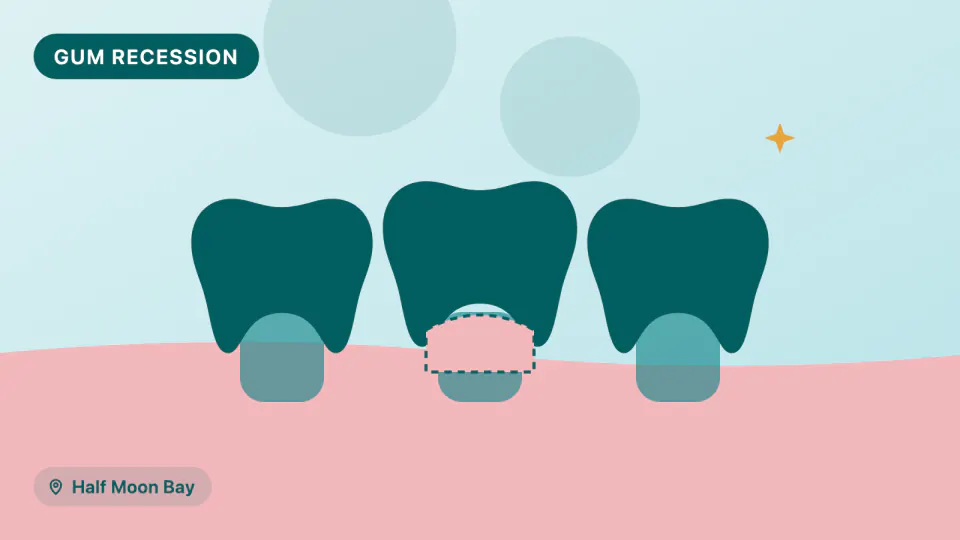
Gum recession treatment in Half Moon Bay: why gums recede, when grafting is worth considering, how your own tissue compares with substitutes, and what to expect.
Receding gums can often be treated with gum grafting when surgery is appropriate. A recent systematic review of randomized trials found that root coverage surgery can improve both how teeth look and how patients feel about the result. Your own gum tissue is still widely regarded as the benchmark graft material, while collagen substitutes trade some of that predictability for a shorter surgery with less discomfort at the donor site. If you live in Half Moon Bay and have noticed longer-looking teeth, the first step is working out why the gums receded and whether it is still progressing.
This article is general education, not a diagnosis. Whether you need treatment depends on an exam by a licensed dentist or periodontist.
Why do gums recede, and when should they be treated?
Recession is rarely caused by one thing. Research describes it as multifactorial, meaning several factors usually stack up. The most common ones include:
- Brushing trauma: a hard-bristled brush or heavy scrubbing can wear gum tissue away over time.
- Gum disease: bacterial infection destroys gum tissue and the bone beneath it.
- A thin gum type: some people simply have more delicate tissue at the gumline, and it is more prone to pulling back.
- Tooth position, grinding, and lip or tongue piercings: all of these can add stress to the gumline.
- Genetics: some people may be more prone to recession because of thin gum tissue or inherited traits.
Gums do not grow back on their own. That does not mean every receded gumline needs surgery. Dentists often begin with the basics: improving plaque control, softening brushing habits, addressing a grinding habit, fixing an overhanging filling, and using desensitizing products for sensitivity. If the recession is stable, small, and not bothering you, careful monitoring and preventive care are a reasonable plan.
Treatment becomes worth discussing when recession is progressing, the exposed root is sensitive or prone to decay, there is too little firm, attached gum left around a tooth, or the appearance bothers you. A dentist will typically measure the recession and compare it at later visits to see whether it is changing.
Gum graft or graft substitute: what does the evidence show?
Your own tissue is widely regarded as the benchmark
The traditional approach uses a connective tissue graft, taken from the roof of your mouth and placed over the exposed root. Reviews of the research continue to describe this as the most predictable option for both single and multiple areas of recession. The trade-off is a second surgical site at the palate, which adds time in the chair and can add soreness during healing.
Collagen substitutes: shorter surgery, less pain, somewhat less gain
A 2025 meta-analysis pooled four small randomized trials that compared a collagen matrix with the patient's own graft for multiple recessions over 12 months. Substitutes are generally associated with a shorter operation and less pain afterward, while the patient's own tissue has tended to give somewhat better reduction in recession and more thickening of the firm gum band. A substitute may be suggested for people who do not have enough palate tissue, who have certain medical conditions, or who would rather avoid a donor site. Only four trials were included, so this evidence is still maturing.
Flap design: tunnel or coronally advanced
Two common ways of positioning the gum over the graft are the tunnel technique and the coronally advanced flap. A recent analysis of the research found both can work well when combined with a graft. The pooled numbers did not show one clearly beating the other, and some trials favored the flap for root coverage while others pointed to the tunnel for comfort and appearance. Studies varied a lot in design, so choosing between them usually comes down to the pattern of recession, your gum thickness, and the surgeon's experience rather than a proven winner.
What can you realistically expect?
Recent systematic reviews of randomized trials have been encouraging overall. Root coverage surgery improved appearance as judged by clinicians and by the patients themselves. Many patients report manageable discomfort, though the palate donor site can be sore for days to a couple of weeks; a dentist can explain what to expect and how it is managed. Individual outcomes still vary, so keep these points in mind:
- Coverage can be substantial without being perfect. Complete coverage of every exposed root is not guaranteed, particularly when recession is advanced or bone has been lost.
- Patient satisfaction does not depend only on the exact percentage covered. Many people are pleased when sensitivity improves and the gumline looks more even.
- The long-term result depends on the cause. If heavy brushing or untreated gum disease is still going on, the problem can return, so good home care and regular maintenance visits matter.
- Research is still developing. Trials differ in how they define success, and long-term data on newer substitute materials is limited.
What are the risks of gum grafting?
Like any surgery, gum grafting carries risks. These can include graft failure or incomplete coverage, bleeding, swelling, infection, ongoing or new tooth sensitivity, and complications at the palate donor site. Smoking is a well-known factor that can interfere with healing and worsen outcomes, so it is worth discussing openly with your dentist or periodontist. A thorough exam and a frank conversation about your health history help determine whether surgery makes sense for you.
Getting gum recession care from Half Moon Bay
Some patients on the coast, including Princeton-by-the-Sea, El Granada, and Moss Beach, wonder whether a consultation is worth the trip. Our office in Belmont is about 25 to 30 minutes east over Highway 92, depending on traffic. A consultation is a chance to talk through your options before deciding on any treatment. We can evaluate your gums and coordinate care with a periodontist when surgery is appropriate. To learn how we care for coastal patients, see our page on the best dentist in Half Moon Bay, CA.
Cost varies with how many teeth are involved and which graft material is used, and many PPO plans cover part of gum grafting depending on the plan. Our team can help you review your benefits and discuss an estimate for any recommended treatment. Financing through CareCredit or Proceed Finance, including 0% APR options, is available, as are in-house membership plans.
Common questions about gum recession treatment
Q: Is a gum graft painful?Many patients report manageable discomfort, though the palate donor site can be sore for days to a couple of weeks. Discomfort is often greater at the donor site than at the graft site, and substitutes tend to cause less pain because no donor tissue is taken. Your dentist can explain what to expect and how it is managed.
Q: Can receding gums grow back without surgery?No. Gum tissue does not regenerate on its own. Better brushing, treating gum disease, and addressing grinding can help slow or prevent further loss, but surgery is how lost tissue is replaced.
Q: Is a substitute material as good as my own tissue?Substitutes can be a sensible choice in certain situations and make surgery shorter and more comfortable. Current evidence still tends to favor your own tissue for the amount of recession reduction and thickening of the gum band.
Q: Does a child's or teen's gum recession need treatment?Some parents wonder about this. A dentist can check for causes like crowding or brushing habits, and often monitoring is enough before any surgery is considered.
If you have receding gums and want to understand your options, we would be glad to help. Our office serves patients in Half Moon Bay and nearby cities across San Mateo County. Call (650) 591-1984 or visit carlmontdentalcare.com to schedule a consultation.
This article is general education, not a diagnosis; whether you need treatment depends on an exam by a licensed dentist or periodontist.
From our patients
★★★★★“I have been a patient for several years. Minimal, if any waiting at all, for appointments whenever I arrive. The hygienist and Dr.s are extremely gentle and very friendly. It is nice to not dread going to a dental appointment.”
★★★★★“I was referred to Dr. Jiang by a good friend of mine (I was having terrible luck finding a Dentist). First may I say I was very impressed upon arrival. Not only was the staff super friendly and helpful checking in as a first time patient, but the office itself was super clean and well maintained.”