Dental Implants in Belmont, CA: Screening & Long-Term Success
· Carlmont Dental Care
What recent research shows about implant screening, risk factors like smoking and diabetes, and long-term survival, explained for patients considering implants in Belmont, CA.
Dental implants remain one of the most reliable ways to replace a missing tooth, but recent research makes clear that success depends on more than the surgery itself. A large 2025 review of implant research found that gum inflammation around implants is fairly common over time, while implants that are properly screened, placed, and maintained still show excellent long-term survival, often exceeding 94 percent at 10 years or more. For Belmont patients considering this option, that finding shapes how a thorough consultation should work: careful screening up front, honest conversation about risk factors, and a maintenance plan that continues for the life of the implant.
What Makes Someone a Good Candidate for Dental Implants?
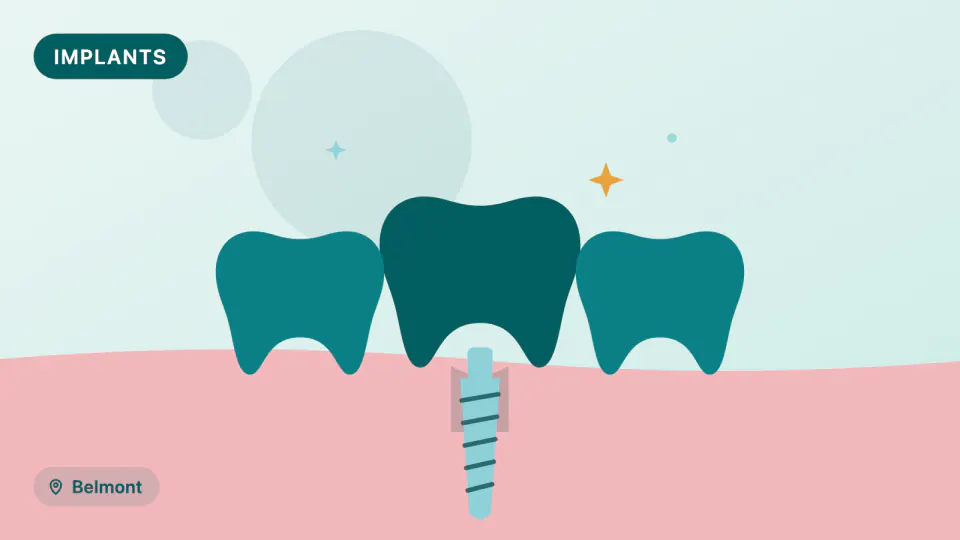
A dental implant is a titanium post placed in the jawbone to replace a tooth root, topped with a crown, bridge, or denture. Most healthy adults with enough jawbone density are reasonable candidates, but a proper screening looks at more than whether a tooth is missing.
Key factors your dentist at Carlmont Dental Care will review include:
- Gum health: A history of periodontitis is one of the strongest predictors of future problems around an implant, so active gum disease is treated and stabilized first.
- Diabetes control: Well-managed diabetes generally doesn't rule out implants, but poorly controlled blood sugar is linked to higher complication risk and slower healing.
- Smoking and alcohol use: Tobacco interferes with healing and blood flow to gum tissue, and research also links heavier alcohol use to more inflammation around implants.
- Bone volume: Enough bone width and height is needed to anchor the implant; a bone graft may be recommended first if bone has resorbed after long-term tooth loss.
- Medical history: Certain medications, uncontrolled autoimmune conditions, or prior jaw radiation can change the plan, which is why a full health history is part of every consultation.
None of these are automatic disqualifiers on their own. They're simply what an honest screening weighs before recommending implants over alternatives like a bridge or partial denture.
Screening Close to Home for Belmont Patients
Patients come in from all over Belmont for implant consultations, and many live close enough that logistics are simple; from neighborhoods like Carlmont, Cipriani, and Hallmark, most addresses are within a short walk or a drive of well under 10 minutes to our Carlmont Drive office. That matters because a proper implant workup usually takes more than one visit: an exam and imaging, a conversation about medical history and risk factors, and sometimes a referral for a CT scan or specialist opinion before a final plan is set.
If you're comparing dentists in the area, see the best dentist in Belmont, CA page for a broader look at our cosmetic and restorative care. For implants specifically, the first visit is almost always diagnostic, not a same-day surgery decision.
What the Latest Research Says About Long-Term Success
A joint 2025 systematic review and meta-analysis, pooling data from more than 100 studies and over 13,000 implant patients, gives one of the clearest pictures yet of what happens around implants over time. It found that inflammation limited to the gum tissue around an implant (peri-implant mucositis) affects roughly half of implant patients at some point, while a more serious form that also affects supporting bone (peri-implantitis) affects around one in five. The strongest risk indicators identified for the bone-involving form: a prior history of periodontitis, diabetes, smoking, and heavier alcohol use.
It's worth being precise about what this does and doesn't mean. These figures describe inflammation around the implant over years of follow-up, not implant failure itself. Long-term survival data, tracked separately, continues to show titanium implants holding up well past the 10-year mark, with cumulative survival commonly cited above 94 percent. Together, the research points to a consistent message: implants are a durable, well-studied solution, but the tissue around them needs the same long-term attention as natural gums, arguably more.
Keeping an Implant Healthy for Life
Because peri-implant inflammation is common and largely preventable, ongoing maintenance is part of the treatment, not an optional extra. Most dental teams recommend a maintenance visit roughly every three to six months for implant patients, with a check of the gum tissue, measurement of any pocketing, and a professional cleaning using instruments safe for implant surfaces. At home, that pairs with daily brushing, interdental brushes or floss designed for implants, and prompt attention to bleeding, swelling, or looseness.
For patients managing diabetes or who smoke, that schedule is often tightened rather than skipped, since those are exactly the risk factors the 2025 review flagged. Belmont patients who ask about implant longevity are often surprised how much of the long-term outcome is in their hands after healing, not just in the surgery itself.
Common questions about dental implants
Q: How long does the implant process take from start to finish?
Healing time after placement typically runs several months before a permanent crown is attached, though timelines vary with bone quality, whether a graft is needed, and individual healing. Your dentist will lay out a realistic timeline at the consultation.
Q: Can I get implants if I have diabetes?
Often, yes, especially if blood sugar is well controlled. Uncontrolled diabetes raises complication risk and slows healing, so your dentist may coordinate with your physician before scheduling surgery.
Q: What does an implant cost, and does insurance cover it?
Cost depends on the number of implants, whether a bone graft is needed, and the restoration type, so we provide a written estimate after your consultation rather than a single number. Most PPO plans offer partial coverage, and our in-house membership plans, starting at $30 a month, plus 0% APR financing through CareCredit or Proceed Finance, are available for patients without dental insurance.
Q: What happens if I already have gum disease?
Active periodontitis is typically treated first, since it's one of the strongest predictors of problems around a future implant. Once gum health is stabilized, many patients move forward successfully.
Q: How often do I need checkups after getting an implant?
Most patients return every three to six months for a maintenance visit, plus daily brushing and interdental cleaning at home. This is the single biggest factor in avoiding the gum inflammation described in recent implant research.
If you're weighing dental implants and want a straightforward read on candidacy, our team welcomes patients from Belmont and nearby San Mateo County communities for a consultation. Call (650) 591-1984 or visit carlmontdentalcare.com, we'll review your health history and imaging and give you an honest picture of your options before anything is scheduled.
From our patients
★★★★★“Dr Jiang took over the practice from a corporate group that previously ran it. The corporate group was after money. I had three different dentists in three visits and the dentists didn't seem that interested. Dr Jiang is a breath of fresh air. I have had teeth cleanings, cavities filled, a crown and and an implant.”
★★★★★“Great people! Everyone smiled and made me feel good about coming here for my dental needs. Nancy helped me remove the Invisalign attachments, the whole process really felt like a family dental care, were very personable and caring, and worked with me as best they can to plan and resolve my crown problem.”