Dental Implant Maintenance in San Carlos: Why Recalls Matter
· Carlmont Dental Care
An implant isn't finished when the crown goes on. See what recent research says about maintenance visits, recurrence of gum and bone problems, and how a personal schedule helps protect your implant.
A dental implant needs ongoing care after the surgery, and that care is part of the treatment. Recent research links regular, tailored maintenance visits with healthier gums and bone around implants, though the evidence is still maturing and no schedule guarantees an implant will last. A good plan combines careful home cleaning with professional checkups timed to your own risk level.
Is an implant really "done" once the crown is placed?
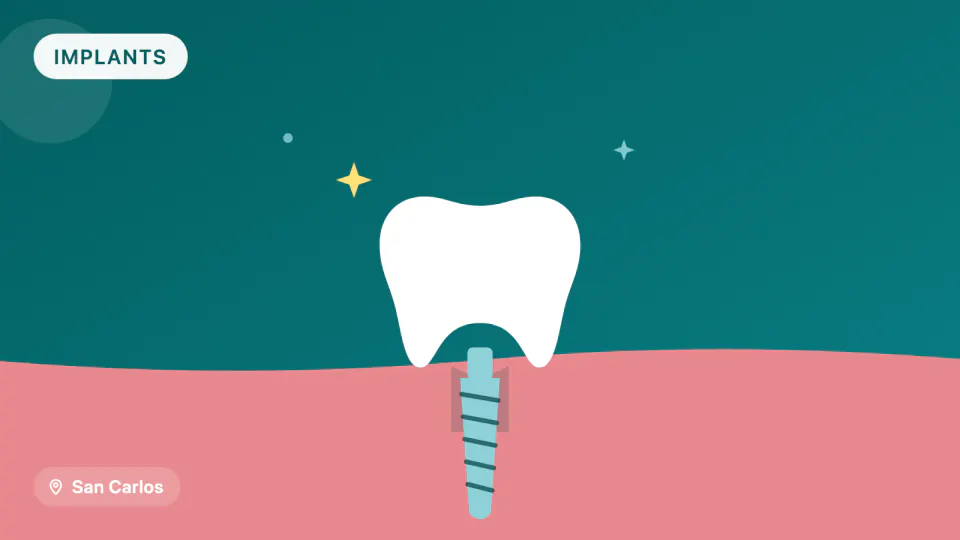
Not quite. The titanium post can't decay, but the gum and bone that hold it in place can still become inflamed. Implants don't have the same natural attachment to the surrounding tissue that a tooth does, so bacteria and plaque can cause trouble faster than many people expect.
Gum inflammation around an implant comes in two stages. The early stage, called peri-implant mucositis, affects only the soft tissue and can often be reversed when it's caught early. The later stage, peri-implantitis, also involves loss of the supporting bone and usually needs more involved, often surgical, treatment. Maintenance visits are largely about catching the first stage before it becomes the second.
What does the recent research actually show?
Several recent reviews of the published studies point in the same direction, with some honest caveats.
- Showing up helps. A recent review of seven long-term studies found that patients who kept their supportive-care visits generally had shallower pockets, less bleeding, and fewer lost teeth than those who didn't. Only two of those studies looked at implants specifically, and both found more deep pockets, bone loss, and peri-implantitis among patients who attended irregularly. That's encouraging, but it's a small body of evidence, and the studies measured adherence in different ways.
- Recurrence is a real concern. A review of eight studies, covering 288 patients and 512 implants treated for peri-implantitis, found that disease came back in roughly 28 percent of cases after one year and about 47 percent after two years. Visits every three months were associated with slightly less recurrence, but recurrence still climbed over time.
- The best interval isn't settled. An earlier review concluded that supportive care may help keep tissues stable after treatment. It also noted that studies defined "recurrence" very differently, so reported rates ranged widely, and that more research is needed on how often visits should happen.
In plain terms: the research supports maintenance as worthwhile and suggests that more frequent visits may help people who have already had problems. It does not yet give a single proven schedule that works for everyone.
Who needs more frequent visits?
Dentists generally tailor the recall interval to the person rather than assigning the same schedule to everyone. Common reasons for closer follow-up include:
- A history of gum disease around natural teeth
- Plaque that builds up quickly or is hard to reach
- Smoking
- Diabetes that isn't well controlled
- A past episode of inflammation around an implant
Many clinicians suggest checking in every three to four months during the first year after the final crown, then adjusting the interval based on how the tissue is responding. Someone with healthy tissue and excellent home care may stretch visits out, while someone with risk factors may stay on a shorter cycle.
What happens at an implant maintenance visit?
A visit is more than a routine cleaning. A dentist or hygienist will typically look for redness and swelling, measure pocket depths with a gentle probe, and check for bleeding or pus, which are early warning signs. They'll also check that the crown and bite are stable and review your cleaning technique.
Cleaning around implants is usually done with plastic or other implant-safe instruments, because metal tools can scratch the surface and make it easier for plaque to cling. X-rays are generally taken when something looks off or to track changes, not necessarily at every visit.
Between visits, home care matters just as much. Brushing twice a day, cleaning between the implant and neighboring teeth with floss or small interdental brushes, and calling the office promptly if you notice bleeding, tenderness, or a bad taste around an implant all help. Stopping smoking is one of the most useful things a patient can do for implant health.
A note for San Carlos families
Questions about long-term implant care come up often from San Carlos patients, whether they live near White Oaks, Howard Park, or Crestview. Our Belmont office at 2100 Carlmont Drive, Suite 8, is typically a 7-to-15-minute drive up El Camino Real or Alameda de las Pulgas, which makes regular recall visits easy to fit around work and school. If you're comparing options for ongoing implant care, you can read more about our practice on our page for the best dentist in San Carlos, CA.
Common questions about implant maintenance
Q: Can an implant get a cavity?The implant itself can't decay, but the gum and bone around it can become inflamed or infected. The crown can also wear or loosen, which is another reason for regular checks.
Q: How often should I come in?It depends on your health and history. Many people are seen every three to six months, and a dentist will adjust that based on how your tissues respond. The research does not point to one perfect interval.
Q: Does insurance cover implant maintenance visits?Coverage varies by plan. We work with most PPO plans, though not HMO or DMO plans, and our team can check your benefits. We also offer in-house membership plans starting at $30 per month and 0% APR financing options for larger treatment.
Q: What if my implant bleeds when I brush?Bleeding is worth a prompt visit. Early inflammation is often reversible, so it's better to have it checked than to wait.
Take the next step
If you have an implant, or you're considering one, we'd be glad to talk through a maintenance plan that fits your health and your schedule. Serving patients in San Carlos and nearby cities across San Mateo County, our team can be reached at (650) 591-1984 or through carlmontdentalcare.com to set up a consultation.
From our patients
★★★★★“Great people! Everyone smiled and made me feel good about coming here for my dental needs. Nancy helped me remove the Invisalign attachments, the whole process really felt like a family dental care, were very personable and caring, and worked with me as best they can to plan and resolve my crown problem.”
★★★★★“I lost a crown on a molar. I made an appointment. They were ready to take me at the correct time and Date. They were efficient and professional a very enjoyable experience.”