All-on-4 Implants in Redwood City, CA: Materials & Timeline
· Carlmont Dental Care
How All-on-4 full-arch implants work, what recent research shows about zirconia vs. acrylic bridges, and what the timeline looks like for Redwood City patients.
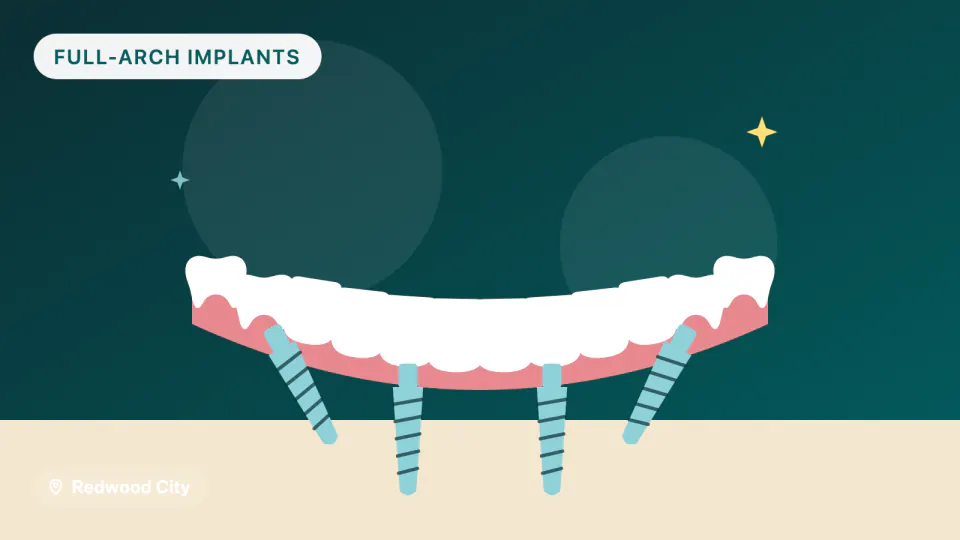
All-on-4 full-arch implants replace a full row of missing or failing teeth using four (sometimes more) implants topped with a fixed bridge, typically over three to six months from surgery to final restoration. Recent research comparing bridge materials shows that zirconia-based prostheses tend to hold up better over time than older acrylic hybrids, with implant survival itself running very high across recent studies. The material chosen up front, and the amount of vertical space planned for it, has a real effect on how the bridge performs years later.
For patients driving in from Redwood City, this is often the first time they're comparing full-arch options seriously, usually after years of failing bridgework or a jaw that just can't support removable dentures anymore. Here's what the current evidence says about materials and timing, and what to expect from a first consultation.
How the All-on-4 Timeline Actually Unfolds
The process generally happens in two phases. On surgery day, any remaining failing teeth are removed, four to six implants are placed in the jawbone, and a temporary acrylic bridge is attached the same day or within 24-48 hours — so patients rarely leave without functional teeth. Over the next three to six months, the implants fuse to the bone in a process called osseointegration; healing tends to run closer to three months in good-quality bone and longer if a bone graft or sinus lift was needed first.
Once integration is confirmed, the team takes final scans or impressions and fabricates the permanent bridge, which is usually delivered over one or two appointments a few weeks later. That final bridge is where the material decision matters most, and it's a decision made before surgery even happens, not after.
The Material Decision That Shapes How Long the Bridge Lasts
Historically, many full-arch bridges were built as a metal framework layered with acrylic teeth — durable enough short-term, but prone to wearing down, chipping, and needing relines or replacement within a handful of years. A recent pooled analysis of a dozen studies comparing bridge materials found that prostheses combining a metal framework with zirconia showed substantially less wear over time than metal-acrylic hybrids, along with a meaningfully lower rate of peri-implantitis, the gum and bone inflammation around implants that can eventually threaten the whole restoration.
Solid (monolithic) zirconia bridges, which skip the metal framework entirely, are also showing strong results: a large laboratory review tracking roughly 3,300 zirconia full-arch cases over five years found survival around 92%, with the leading cause of failure being the framework itself fracturing — and that risk climbed sharply when there wasn't enough vertical space between the implants and the bite for the zirconia to be made thick enough to resist stress. In plain terms: the bite spacing your dentist plans for during the surgical phase directly affects whether the final bridge can be built strong enough to last. This is still a relatively young body of evidence — five-year data is solid, but long-term data beyond that is still maturing, so the takeaway is "comparable or better durability so far," not a guarantee.
What the Research Says About Implant Survival Itself
Separate from the bridge material, the implants themselves have a strong track record. A 2025 prospective study following implants placed under full-arch bridges found survival above 99%, with the small number of failures concentrated almost entirely in patients who smoke. That lines up with older, longer-term data showing smokers lose implants at meaningfully higher rates than non-smokers, particularly in the upper jaw. If you smoke and are considering All-on-4, it's worth discussing honestly at your consult — it changes the risk conversation, not necessarily the eligibility.
Why This Matters for Redwood City Patients
We see a steady stream of consults from Redwood City, and the questions are consistent: how long will I be without teeth, what's the bridge made of, and will it hold up. Carlmont Dental Care sits about 10-18 minutes south, reachable via El Camino Real, Alameda de las Pulgas, or 101 plus Ralston Ave, which makes the healing-phase check-ins and final-bridge appointments manageable without a long haul. Patients from Farm Hill, Emerald Hills, and downtown Redwood City tend to ask specifically about the zirconia-versus-acrylic decision once they've done some reading, which is a good sign — it's genuinely the decision that matters most for longevity. If you're comparing providers around the Peninsula, our best dentist in Redwood City, CA page has more on what a consult here involves. The practice is in Belmont, just off the San Mateo County corridor most Redwood City patients already drive for work or errands.
Common questions about All-on-4 implants
Q: How many implants does All-on-4 actually use?
Typically four per arch, though some cases use five or six depending on bone quality and bite forces — your dentist determines this from your CT scan, not a fixed formula.
Q: Will I be without teeth during healing?
No. A temporary fixed bridge is attached the same day as surgery or within a day or two, so you're eating and speaking with teeth in place throughout the healing period, though on a softer diet initially.
Q: Is zirconia always the better choice?
It's showing better wear resistance and lower peri-implantitis risk in recent research, but it requires adequate vertical space to be built strong enough to resist fracture. Your dentist will assess whether your bite and bone structure support it during planning.
Q: Does smoking disqualify me from All-on-4?
Not automatically, but recent data shows implant failure is concentrated in smokers, so it's an honest conversation to have at consult — some patients choose to cut back or quit during the healing window to protect the investment.
Q: What does All-on-4 cost?
It varies by case complexity, number of implants, bone grafting needs, and bridge material, so we don't quote flat figures — every patient gets a written estimate after consultation. Carlmont Dental Care offers in-house membership plans starting at $30/month for patients without PPO coverage, plus 0% APR financing through CareCredit or Proceed Finance.
If you're weighing All-on-4 and want a straight answer on timeline, materials, and what your case would involve, call Carlmont Dental Care at (650) 591-1984 or visit carlmontdentalcare.com to schedule a consultation — we work with patients throughout Redwood City, San Carlos, San Mateo, and the rest of the Peninsula, and most PPO plans are accepted.
From our patients
★★★★★“Great people! Everyone smiled and made me feel good about coming here for my dental needs. Nancy helped me remove the Invisalign attachments, the whole process really felt like a family dental care, were very personable and caring, and worked with me as best they can to plan and resolve my crown problem.”
★★★★★“I lost a crown on a molar. I made an appointment. They were ready to take me at the correct time and Date. They were efficient and professional a very enjoyable experience.”