All-on-4 Implants in Menlo Park, CA: Materials, Timeline & Durability
· Carlmont Dental Care
What Menlo Park patients should know about All-on-4 full-arch implants: the surgery-to-final-bridge timeline and what recent research shows about zirconia vs. metal-acrylic bridge materials.
All-on-4 replaces a full arch of missing or failing teeth with four to six implants and a fixed, non-removable bridge (sometimes called All-on-5 or All-on-6 when extra implants are used), typically completed in two phases: a surgery-and-temporary-bridge visit, then a final prosthesis four to six months later once the implants have fused to the jawbone. Recent research comparing the two most common bridge materials, zirconia versus metal-acrylic hybrid, found zirconia wears far less over time and is linked to a lower rate of inflammation around the implants, though hybrids remain reasonable for some budgets. For Menlo Park patients weighing this procedure, the material decision made before surgery is one of the more consequential choices in the process, alongside surgical skill, bone quality, and long-term hygiene.
How All-on-4 Works
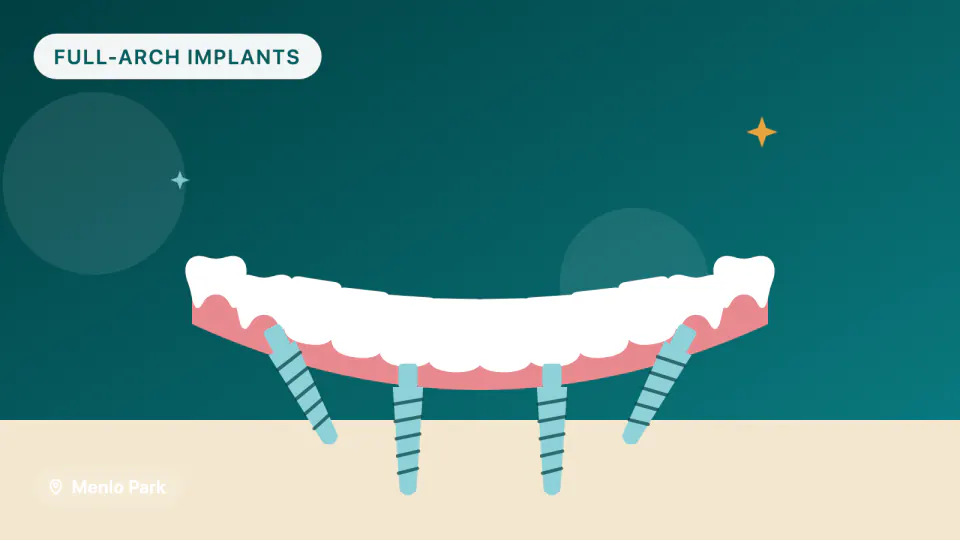
Unlike traditional implants that replace one tooth at a time, All-on-4 anchors a full arch of replacement teeth on a small number of implants, often angled toward denser bone in the back of the jaw to avoid grafting. It's built for patients missing most or all of their teeth in an arch, or whose remaining teeth aren't worth saving individually. Patients from Menlo Park often ask about this procedure, usually after years of loose dentures or teeth failing one by one. For more on the practice and what a first visit looks like, the best dentist in Menlo Park, CA page has an overview of services and how local patients typically get started.
The Timeline: Surgery, Healing, and the Final Bridge
Surgery day usually takes several hours per arch: failing teeth are removed, implants placed, and a fixed temporary bridge attached the same day so patients aren't left without teeth. The jawbone then needs three to six months to fuse to the implants, sometimes longer in the upper jaw, where bone tends to be softer. The temporary bridge is intentionally lighter and less durable than the final one; it's a placeholder. Once integration is confirmed, it's replaced with the definitive bridge, where the material decision comes in.
Zirconia or Metal-Acrylic Hybrid? What Newer Research Shows
A 2026 meta-analysis pooling 12 studies on full-arch implant bridges found zirconia-topped bridges wore down far less than metal-acrylic hybrids and were linked to a meaningfully lower rate of peri-implantitis, the gum and bone inflammation that can threaten implants over time (source: 2026 systematic review and meta-analysis comparing zirconia and metal-acrylic full-arch implant prostheses, published in a peer-reviewed prosthodontics journal). Marginal bone loss also trended in zirconia's favor, though more modestly. Notably, implant survival itself didn't differ much between materials; the advantage shows up in the surrounding tissue and the bridge's durability, not necessarily whether the implants stay put.
A separate, larger retrospective review of roughly 3,300 monolithic zirconia full-arch bridges tracked five-year outcomes near 92 percent survival, with the leading failure a cracked or broken framework, most often tied to a bridge made too thin for lack of vertical space between jawbone and opposing teeth (source: 2026 multicenter retrospective study of monolithic zirconia full-arch implant prostheses, published in a peer-reviewed dental journal). That's a planning issue, not a material flaw, which is part of why imaging and a careful bite assessment matter before committing to a zirconia design. Separately, prospective data following several hundred implants under dozens of full-arch bridges showed implant survival above 99 percent overall, with losses skewing toward patients who smoke, consistent with the broader pattern in implant literature of smoking as a significant risk factor regardless of bridge material.
None of this makes acrylic hybrids obsolete; they're lighter, easier to repair chairside, and often more budget-friendly. But the evidence is fairly consistent: for patients hoping to minimize bridge repairs or gum inflammation over the years, zirconia has a stronger track record in these studies, provided there's adequate space to build it properly. This is still a developing body of evidence, so it's worth treating as a directional signal rather than a guarantee, and discussing with a dentist against your own bone and bite scans.
What Determines the Cost, and How Patients Pay For It
Pricing varies with the number of implants, whether teeth need extraction first, whether bone grafting is needed, and which bridge material is chosen. Bay Area dental costs generally run higher than the national average, and full-arch cases involve both surgical and lab fees, so a number isn't quoted until a scan has been reviewed and a written plan put together. In-house membership plans can offset routine care leading up to treatment, and financing options through third-party providers like CareCredit or Proceed Finance may offer interest-free or reduced-rate terms for larger cases; ask at consultation for current details.
Patients from Menlo Park sometimes ask if the drive to Belmont is worth it. It's roughly 15 to 18 minutes south on Highway 101 from Menlo Park, a manageable trip for a procedure spread over several visits, especially for patients whose regular San Mateo County dental home doesn't offer implant surgery in-house.
Common questions about All-on-4 implants
Q: How long does the whole process take?Most patients are looking at four to six months from surgery to final bridge, though healing can run longer in the upper jaw or when grafting is needed. The temporary bridge is functional throughout, so patients aren't without teeth during healing.
Q: Is zirconia always the better choice?Not automatically. It holds up better against wear and is linked to lower inflammation rates in recent studies, but needs enough vertical space to be built with adequate thickness, and costs more than a hybrid. A dentist will typically evaluate bone and bite space before recommending one material over the other.
Q: Does smoking affect the outcome?Research consistently flags smoking as one of the stronger risk factors for implant complications and failure, including in full-arch cases. Smokers aren't automatically excluded from treatment, but it's worth discussing honestly at consultation since it affects healing.
Q: Will I need a bone graft?Not necessarily. One appeal of All-on-4 is that implants are often angled to use existing bone in the back of the jaw, avoiding the graft surgery older techniques required. A scan during consultation will confirm whether your case needs additional bone support.
If you're in Menlo Park or nearby and want to know whether All-on-4 makes sense for your situation, a dentist can review a scan, walk through material options, and put together a written plan with real numbers. Call (650) 591-1984 or visit carlmontdentalcare.com to schedule a consultation.
From our patients
★★★★★“Great people! Everyone smiled and made me feel good about coming here for my dental needs. Nancy helped me remove the Invisalign attachments, the whole process really felt like a family dental care, were very personable and caring, and worked with me as best they can to plan and resolve my crown problem.”
★★★★★“I lost a crown on a molar. I made an appointment. They were ready to take me at the correct time and Date. They were efficient and professional a very enjoyable experience.”